
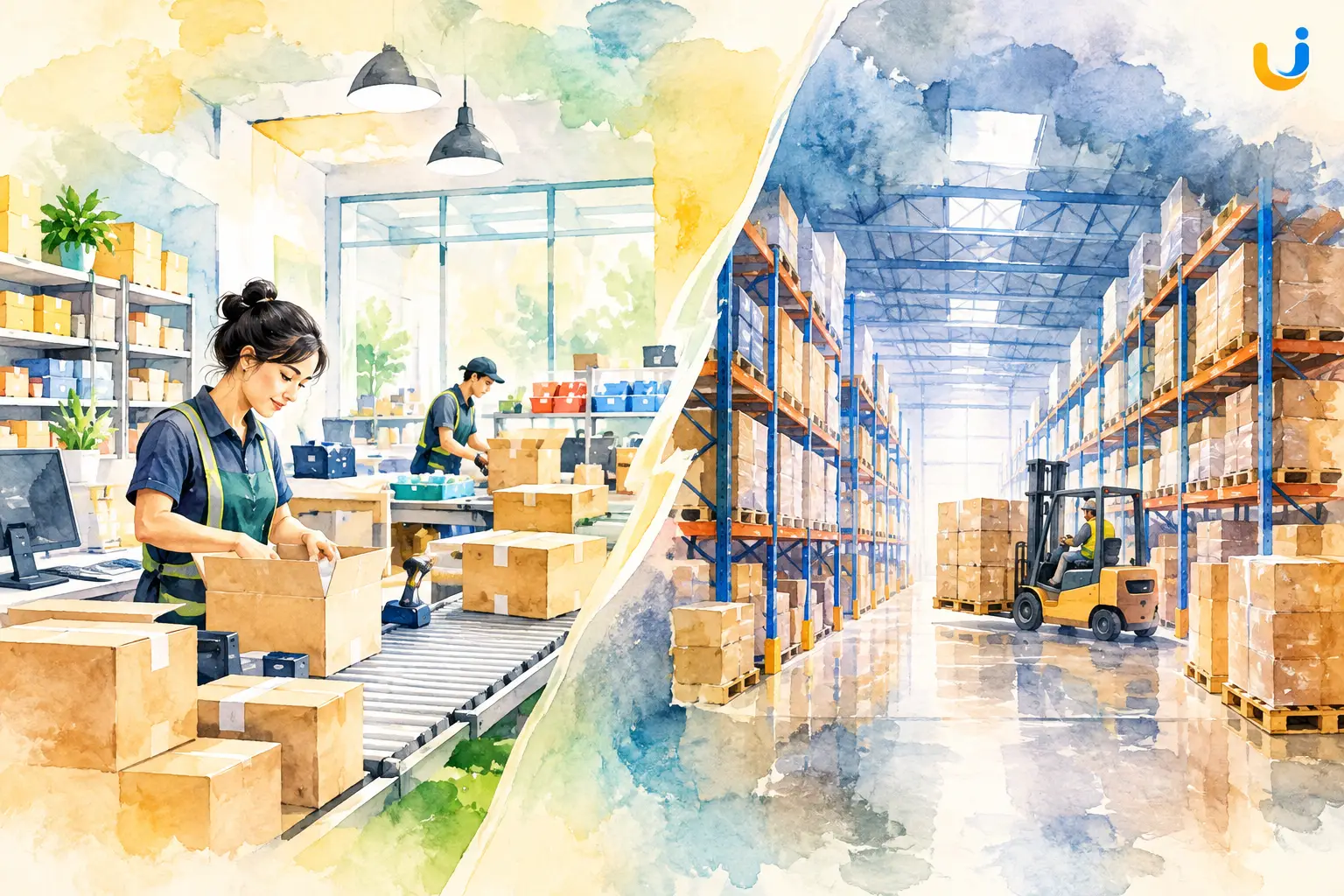
A warehouse can hold 20,000 units of your bestselling water bottle without breaking a sweat. Then someone buys one on TikTok Shop at 10.43pm, chooses next-day delivery, and suddenly that warehouse has the personality of a sleepy filing cabinet.
That is the practical difference in the fulfilment centres vs warehouses debate. One is designed to keep stock safe. The other is designed to make individual customer orders disappear out the door accurately, quickly and with fewer apologetic emails from your support team.
They can occupy similar-looking buildings. Both have racks, pallets, barcode scanners and at least one person who knows exactly where everything is. But they serve different commercial jobs. Mixing them up is how a growing online business accidentally buys itself a very expensive storage problem.
What a warehouse is actually for
A warehouse is primarily a storage operation. Its job is to receive goods in bulk, organise them, protect them and release them when another business location, distributor or retailer needs replenishment.
Think cartons, pallets and relatively large movements. A skincare brand might import 10,000 cleansers, store them in a warehouse, then send 500 units at a time to department stores or regional distributors. The rhythm is predictable: goods arrive, goods sit, goods leave in bulk.
This makes warehouses useful for businesses with long inventory cycles, wholesale customers or products that do not need daily picking. They can be simpler to run because there are fewer individual orders, fewer packaging decisions and fewer delivery exceptions.
But simple is not the same as ready for ecommerce. The moment a warehouse has to process hundreds of small orders across Shopify, Shopee, Lazada, TikTok Shop and a corporate gifting portal, its operating model changes. Someone now needs to find the right item, check the variation, pack it properly, print the label, update the channel and hand it to the right carrier. Repeatedly. Without sending lavender shampoo to somebody who ordered a phone case.
What makes a fulfilment centre different?
A fulfilment centre stores stock too, but storage is only the quiet bit before the action starts. Its purpose is to receive orders from sales channels and turn them into parcels headed to real people.
That means a fulfilment centre is built around movement. It receives inventory, counts it, puts it away, picks individual items, packs orders, applies shipping labels, arranges collection, handles returns and keeps inventory data current. It is part stockroom, part packing line, part customer experience department with tape guns.
The customer rarely sees it, except when it fails. A delayed parcel, crushed box or incorrect shade of foundation is not filed mentally under “warehouse process”. It is filed under your brand.
The unit of work tells the story
The cleanest distinction is this: warehouses usually move inventory in bulk; fulfilment centres move orders one by one.
A warehouse may send ten pallets to a retailer. A fulfilment centre may ship ten parcels to ten different addresses, each with different products, promotional inserts, delivery preferences and marketplace service-level rules.
Neither model is more sophisticated by default. They are simply optimised for different types of demand. A furniture importer supplying retail chains may need strong warehousing first. A direct-to-consumer snack brand running flash sales probably needs fulfilment muscle before it needs an enormous building full of slow-moving cartons.
Fulfilment centres vs warehouses: where costs really change
It is tempting to compare only storage fees. That is a bit like choosing a restaurant based solely on the price of the chairs.
Warehousing costs tend to centre on space, pallet positions, receiving and large outbound movements. If stock sits for months and leaves in predictable batches, this can be economical. The operation has fewer touches per item.
Fulfilment costs reflect more activity. There may be fees for receiving, storage, picking, packing, packaging materials, special handling, returns and delivery. At first glance, that can look dearer. But it may cost less than hiring staff, leasing space, buying systems, managing carrier cut-offs and spending every Tuesday night investigating why marketplace stock levels are wrong.
The meaningful comparison is cost per successful customer order, not cost per square metre. Include labour, software, error rates, customer support time, lost sales from stock-outs and the awkward cost of a one-star review. Suddenly, a low storage rate can become quite an expensive bargain.
Speed matters, but accuracy pays the bills
Fast dispatch is attractive because online shoppers have been trained by large marketplaces to expect their parcel to move almost immediately. Yet speed without control is merely chaos in a high-vis vest.
A good fulfilment operation uses scanning and defined workflows to make sure the item picked matches the order, the inventory record updates and the parcel goes to the correct carrier. It also plans around sales spikes. A campaign that creates 2,000 orders in an afternoon is a success only if the operations team does not spend the following week living beside a printer.
For Singapore sellers, delivery promises can be especially unforgiving. Customers may be ordering from a sofa at lunchtime and expecting a delivery notification before they have chosen dinner. In Malaysia, brands may need to balance reach, service levels and varying delivery expectations across a larger geography. The logistics model needs to match what was promised on the product page, not merely what looks impressive in a planning deck.
The multi-channel problem most warehouses were not built to solve
Selling through one website is manageable. Selling the same stock across a website, social commerce, marketplaces, retail partners and live-selling sessions is where inventory develops a mischievous side.
If each channel has its own spreadsheet, one successful promotion can sell the same last unit three times. The first customer gets it. The other two get a refund, an apology and an excellent reason to try a competitor.
This is why modern fulfilment is increasingly a commerce function, not just a logistics function. The useful system connects sales channels to the physical stock and gives operators a credible view of what is available. It should handle order routing, stock allocation and marketplace requirements without asking your team to copy and paste order details until their wrists submit a formal complaint.
uParcel operates this model in Singapore and Malaysia as multi-channel fulfilment rather than storage with a delivery add-on. Its cloud-based, commerce-enabled operation can manage marketplace orders, with live studios beside its fulfilment activity for brands selling in real time. The engineering, fleet network, warehouse and commerce teams are owned and directly controlled by uParcel, which matters when an order issue needs fixing across systems, shelves and last-mile delivery rather than being passed around like a cursed group-chat message.
Which model does your business need?
The answer depends less on how many products you have and more on how they move.
A warehouse may be the right fit if you sell largely to other businesses, replenish shops in bulk, have a modest number of outbound movements or need long-term inventory holding. It can also make sense for slow-moving or oversized goods where individual parcel handling is not the core operation.
A fulfilment centre is usually the stronger choice when orders are direct to consumer, volumes fluctuate with campaigns, products are sold on several channels or delivery experience is part of the brand promise. It is particularly valuable when your internal team should be spending time on product, marketing and customers rather than debating the spiritual location of carton 47B.
There is also a middle ground. Many growing brands use warehousing for reserve stock and a fulfilment centre for fast-moving inventory. That can work well, provided replenishment between the two is planned properly. A split model without good inventory visibility is simply two places to lose a bestseller.
The questions to ask before choosing
Before signing for space or outsourcing operations, look at the shape of your orders. How many are single-item parcels versus bulk shipments? How volatile are your sales? Do you need branded packaging, kitting, gift notes or returns processing? Are you selling through marketplaces with strict dispatch targets? And, crucially, what happens when a campaign performs better than expected?
Ask prospective partners about accuracy reporting, cut-off times, inventory integration, peak-season capacity and how exceptions are handled. “We can store it” is not the same as “we can ship 800 personalised orders correctly by tomorrow”. The distinction becomes painfully clear when your brand is trending.
The building is not the strategy. The flow of stock, information and customer promises is. Choose the operation that lets your products move at the speed your customers already believe they deserve.
Leave a Reply