
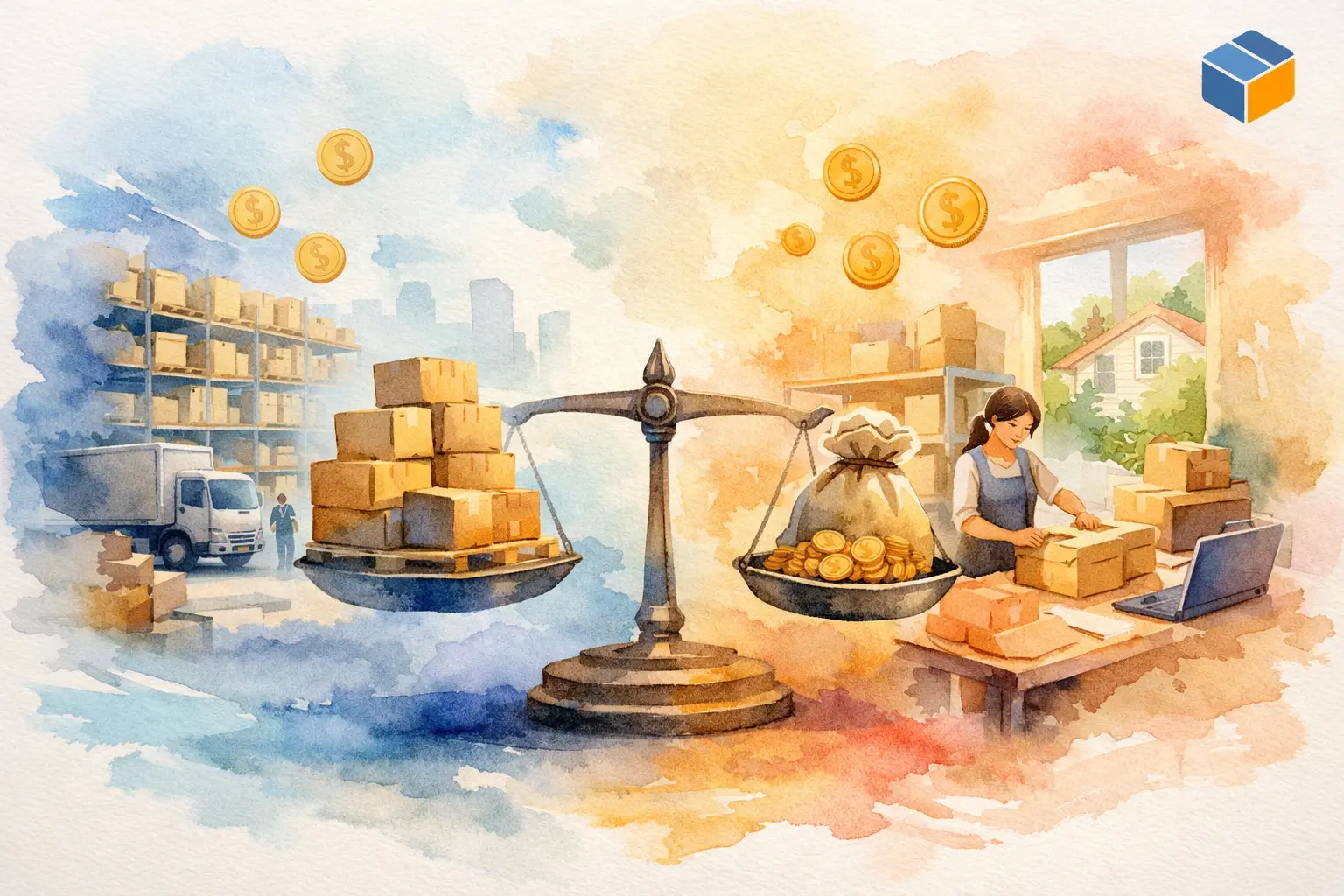
A fulfilment operation can look wonderfully efficient from the outside. Orders leave the warehouse, customers receive tracking updates, someone posts an unboxing video. Behind the curtain, however, there may be a founder printing labels at 11pm beside a tower of cartons that has begun to develop its own weather system. The 3PL vs in-house fulfilment decision is really about whether you should keep feeding that system yourself or hand it to people whose whole job is making parcels behave.
There is no morally superior answer. In-house fulfilment gives you proximity and control. A third-party logistics provider, or 3PL, gives you capacity, systems and fewer reasons to spend your Friday negotiating with a courier about a missing box of moisturiser. The right choice depends on your order volume, product complexity, customer promise and appetite for operational admin.
What you are actually choosing
In-house fulfilment means your team stores stock, picks items, packs orders, books deliveries, manages returns and investigates exceptions. This might happen in your office, shop, spare unit or dedicated warehouse. It can be a smart arrangement when the business is small, products need special handling, or the brand experience depends on a highly personal packing process.
A 3PL performs some or all of that work on your behalf. You send inventory to its facility, orders flow in from your ecommerce store and marketplaces, and the provider picks, packs and dispatches according to agreed rules. Some also manage warehousing, delivery, inventory synchronisation and marketplace operations under one roof.
The difference is not simply “doing it yourself” versus “giving up control”. It is choosing between owning the daily machinery and buying access to machinery built to run at volume.
In-house fulfilment: control is real, so is the bill
The case for in-house is strongest when each order needs a human eye. Perhaps you sell made-to-order gift sets, fragile art, regulated samples, or products where a handwritten note is part of the proposition. Your team can inspect every item, change packaging at short notice and catch odd requests before they become expensive customer-service tickets.
You also see stock directly. That matters when you have 80 units of a popular SKU, an influencer has just posted about it, and every inaccurate inventory number has the potential to become a public apology.
But control has a habit of dressing up as convenience. Initially, fulfilment is a table, a label printer and one diligent colleague. Then orders grow. You need shelving, scanners, packing benches, carrier cut-off procedures, cycle counts, trained cover for annual leave and a plan for the day 400 orders arrive because TikTok has decided your product is the main character.
The cost is not just rent and wages. It is management attention. Founders often price a box, tape and postage, then forget the hours spent reconciling stock, answering “where is my order?” messages and fixing orders that were packed correctly but collected incorrectly. Those are not free because they happen indoors.
3PL vs in-house fulfilment: compare total cost, not headline cost
A 3PL invoice can look more expensive than packing orders internally because it makes each activity visible: receiving stock, storage, picking, packing, delivery and sometimes returns. In-house costs often appear cheaper because they are scattered across payroll, warehouse rent, software subscriptions, packaging purchases and somebody’s increasingly complicated spreadsheet.
For a useful comparison, calculate the fully loaded cost per order. Include labour, supervision, premises, equipment, packaging, insurance, systems, delivery charges, failed-delivery handling and the cost of stock errors. Then model ordinary weeks alongside peak periods. Your average Tuesday is not the test. The week before a major sale is.
A 3PL usually converts several fixed costs into variable ones. That can be particularly useful for brands with seasonal demand, campaign spikes or uncertain growth. You pay for activity rather than leasing space for inventory you may not need in six months.
That said, outsourcing is not automatically cheaper. If volumes are very low, your products are simple, and you already have spare labour and storage, an external operation may add more process than value. It may also be poor value if your order profile is unusually complex and your provider charges for every exception. Read the rate card with the concentration of a person checking their airline’s baggage policy.
Speed matters only when the system can keep its promise
Customers do not care whether a warehouse is owned by you or a partner. They care that the order is correct, the tracking works and the parcel arrives when you said it would. Same-day delivery is impressive right up until it becomes same-day confusion.
A capable 3PL can offer later cut-offs, established courier networks and live delivery visibility without forcing your team to build a miniature transport department. For Singapore-based brands, that can make a meaningful difference where customers expect fast, precise delivery windows and will happily message support after 14 minutes of uncertainty.
In-house teams can be faster for highly local orders or special requests because there is no handover between companies. Yet speed becomes fragile when it relies on a few people knowing where everything is. If one experienced packer is off sick and nobody can find the label stock, the operation has discovered its single point of failure.
Integration is where tidy plans meet real commerce
Selling on Shopify is one thing. Selling across Shopify, Shopee, Lazada, TikTok Shop, retail orders and a corporate portal is another. The moment stock lives in more than one place, inventory accuracy stops being an admin task and becomes a revenue-protection exercise.
An in-house operation can work well with a disciplined warehouse management system and clear processes. The problem is not that internal teams cannot run technology. The problem is that every integration, order-status rule and marketplace update needs someone to own it when it breaks.
A 3PL with proper channel integrations can bring orders into one workflow and update stock as items are picked and shipped. That reduces overselling and the manual copying that turns a successful promotion into a small archaeological dig through spreadsheets. Providers such as uParcel can also combine fulfilment with delivery tracking, which matters when operations teams are tired of stitching together five dashboards to answer one customer question.
Before outsourcing, ask precisely how orders flow, when stock updates, what happens during an integration failure and who investigates discrepancies. “It integrates” is not an answer. It is a trailer for the answer.
When in-house is the better call
Keep fulfilment in-house when your volume is manageable and stable, your products need frequent bespoke handling, and your team has a genuinely efficient operation rather than a heroic one. It can also make sense if fulfilment is central to your brand experience, such as luxury gifting where presentation is part of what customers buy.
You should also hesitate before outsourcing if your product needs specialised knowledge that a provider cannot reliably train for. Medical devices, cold-chain goods and regulated inventory are not ordinary cartons with more paperwork. Choose a partner with the relevant controls, or retain the work until you can.
When a 3PL earns its keep
A 3PL is usually worth serious consideration once fulfilment starts limiting growth. Common signs include staff spending too much time packing, storage becoming cramped, stock counts drifting, delivery performance varying by courier, or marketing being forced to avoid campaigns because operations cannot absorb the volume.
It is particularly useful when you need more than storage and dispatch. Multi-channel order management, same-day delivery, recipient notifications, returns processing and regional expansion each introduce separate operational demands. Buying these capabilities through one accountable partner can be more sensible than building a patchwork operation held together by goodwill and temporary passwords.
The goal is not to outsource responsibility. It is to move routine execution to specialists while keeping ownership of your customer promise, product data and service standards.
Choose a model that can survive good news
Do not choose based on the quietest month of the year. Choose for the day a campaign works, a marketplace sale lands, or a corporate client doubles its order. Ask whether your current setup can ship accurately, communicate clearly and recover gracefully when something goes wrong.
Good fulfilment is almost invisible. That is the point. Your customers should remember the product, not the logistical gymnastics required to get it to their door.
Leave a Reply