
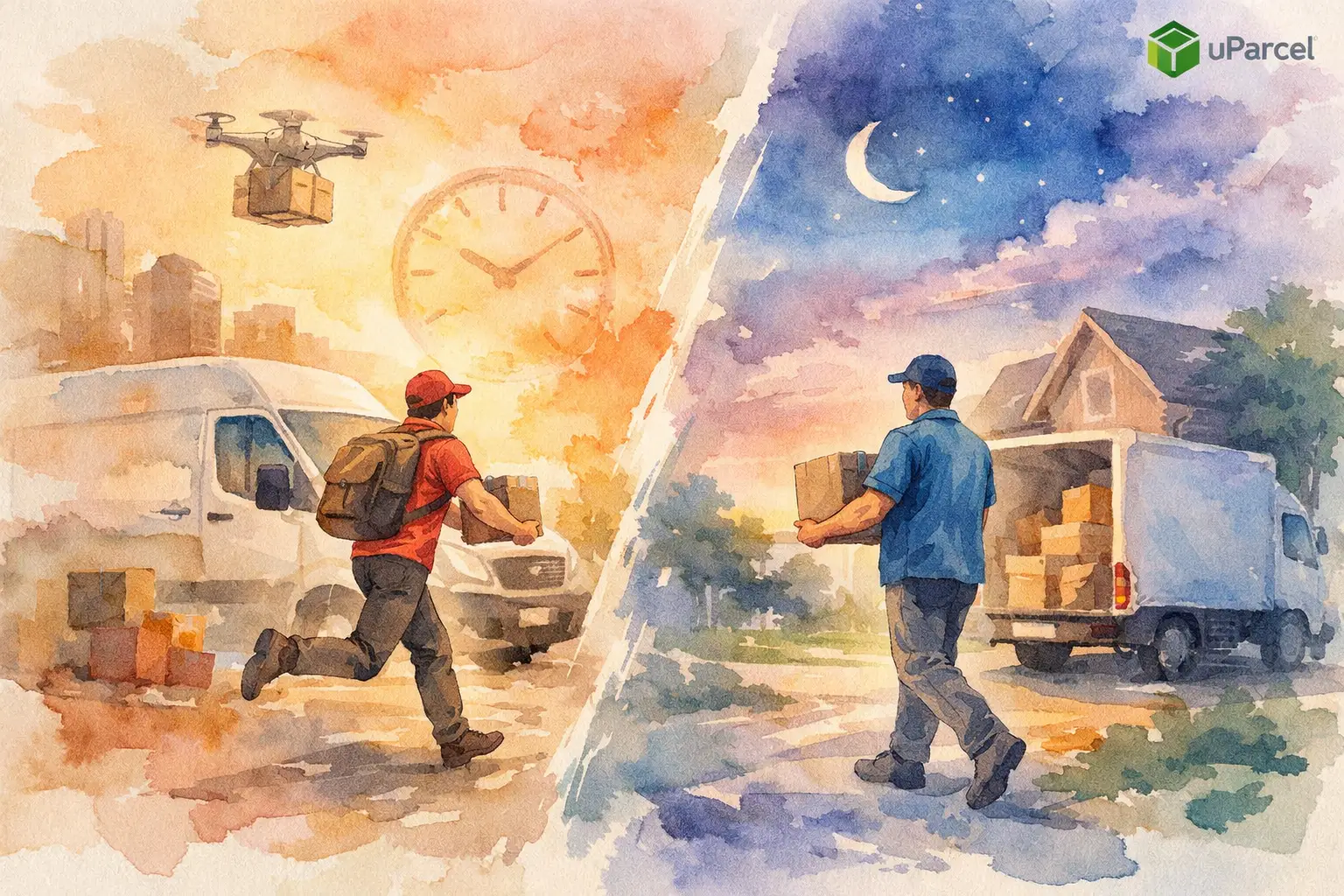
A customer who needs a birthday gift by 7pm does not care that your warehouse achieved a beautiful 99.8% pick accuracy last quarter. They care whether the parcel arrives before the cake is cut. That is the real question behind same day vs next day delivery: not which option sounds faster on a banner, but which promise your business can keep without setting fire to its margins.
For Singapore retailers, speed is now part of the product. A skincare refill, urgent document, replacement charger or medical device can all become unexpectedly time-sensitive. But offering the fastest possible delivery to everyone is a little like hiring a Formula 1 driver for the school run: impressive, expensive, and occasionally unnecessary.
Same Day vs Next Day Delivery: The Practical Difference
Same-day delivery means an order is collected, processed and delivered within the same calendar day, often in a chosen time window. It is built for urgency. Next-day delivery means the order arrives on the following working day, usually after a later order cut-off and with more room for planned routing.
That one extra night changes more than the customer’s wait. It changes how you pick inventory, when your team packs orders, how many delivery runs are needed, and how much disruption a late order can cause.
Same-day is a premium operational promise. Next-day is a planning advantage. Neither is automatically better.
Same-day delivery sells certainty when timing matters
The strongest case for same-day is not impatience. It is consequence. If a customer has run out of infant formula, needs a corporate gift before an event, or requires a temperature-sensitive healthcare item, tomorrow may be functionally useless.
For these orders, same-day delivery can protect revenue that would otherwise disappear at checkout. It also reduces the awkward gap between a customer clicking “buy” and wondering whether their order has fallen into the parcel equivalent of the Bermuda Triangle.
It can be especially effective for categories where the purchase is emotional, urgent or occasion-led: flowers, gifts, beauty replenishments, electronics accessories, office supplies and selected healthcare products. A well-timed delivery promise can be the difference between winning an order and watching it wander off to a marketplace competitor.
The catch is that same-day delivery puts your operation on a clock. Stock must be accurate. Pickers must be available. Packing cannot become an arts-and-crafts session. Dispatch handovers need discipline. And recipients need clear updates, because a courier waiting in the locked lobby of a block of flats is not a delivery strategy.
Next-day delivery is often the grown-up choice
Next-day delivery sounds less glamorous, mostly because nobody has made a thriller about a parcel arriving responsibly tomorrow. Yet for many e-commerce businesses, it is the service that produces the best balance of customer satisfaction, cost control and operational sanity.
With next-day delivery, orders can be batched. Routes can be planned more efficiently. Warehousing teams can work to clearer cut-off times rather than chasing each new order like a waiter carrying too many plates. The result is often fewer failed deliveries, fewer expensive exceptions and more predictable costs.
For routine purchases – apparel, homeware, pantry goods, standard consumer electronics and repeat B2B supplies – next-day delivery usually meets the customer’s actual expectation. Especially when the promise is specific. “Delivered tomorrow” is more reassuring than a vague “ships in one to three business days”, a phrase that has caused more customer-service tickets than it deserves.
Next-day also gives smaller teams breathing room. If you are processing orders across Shopify, Shopee, Lazada and TikTok Shop, a sensible next-day cut-off can prevent the warehouse from becoming a live-action group chat.
The Cost Question Nobody Can Avoid
Delivery speed has a cost curve, not a switch. Same-day delivery generally costs more because it requires tighter cut-offs, faster dispatch and less opportunity to consolidate orders or optimise routes. It may also create more labour pressure during peak periods.
That does not mean it is poor value. It means the value must be visible somewhere. You might charge a delivery fee, set a minimum basket value, reserve it for loyalty members, or offer it only in selected zones and for eligible items.
A premium delivery option should not quietly eat the profit from a modest order. Selling a £12 equivalent item with a heavily subsidised urgent delivery is generous, certainly. It is also a surprisingly efficient way to turn growth into a hobby.
Next-day delivery offers more scope for flat, predictable pricing. When orders can be consolidated and scheduled, businesses gain a clearer view of fulfilment spend. This matters when delivery volumes rise and finance starts asking inconvenient but reasonable questions.
Calculate the full cost, not just the courier fee
The delivery charge is only one part of the equation. Look at the extra picking labour, packaging cut-off, customer-service workload, failed-delivery risk and any inventory movement needed to position stock closer to customers.
Also consider conversion. If same-day delivery lifts conversion on high-margin products or rescues last-minute purchases, it may pay for itself. If it is used mainly by customers buying low-margin essentials, you may need firmer eligibility rules.
The useful metric is contribution margin per delivered order, not the comforting sight of a high order count.
Choose by Customer Need, Not by Competitive Panic
Competitors offering same-day delivery can make every founder feel as though they have arrived late to a party everyone else knew about. Resist the reflex to copy the badge before checking whether customers want it.
Start with order data. When do orders arrive? Which products trigger pre-sale questions about delivery timing? How many buyers need an item today, versus simply wanting assurance it will not arrive next week? Review abandoned baskets and customer-service messages too. They tend to be brutally honest.
A sensible service design might make same-day available for orders placed before an afternoon cut-off, within selected delivery zones, while next-day remains the standard option. Customers who need speed get a clear route to it. Everyone else gets a dependable promise that does not require your operations team to develop stress-related hobbies.
For B2B and healthcare distribution, service levels may need to be even more deliberate. A clinic replenishing approved devices, for example, may value scheduled next-day delivery with proof of delivery and controlled handling more than a broad same-day offer. Urgency should be tied to the use case, not sprinkled over every parcel like chilli flakes.
Delivery Promises Are Warehouse Promises
The website makes the promise, but the warehouse has to honour it. That is why delivery choices cannot be separated from fulfilment design.
If your stock records are wrong, same-day delivery simply gets the wrong item to the customer faster. If marketplace orders are not synchronised, next-day delivery becomes a rescue mission after an oversell. If packing stations are poorly organised, a fast service turns into a queue with nicer branding.
Businesses scaling across channels need order management, inventory visibility and delivery dispatch to work as one operation. A fulfilment partner such as uParcel can connect the unglamorous but essential parts – storing stock, picking, packing, integrating orders and tracking the final delivery – so speed is based on a repeatable process rather than heroic improvisation.
Recipient communication deserves equal attention. Active notifications, accurate tracking and a clear delivery window can make next-day delivery feel reassuringly premium. Conversely, same-day delivery with no updates feels less like convenience and more like waiting for a plumber who said they would come “sometime after lunch”.
When Same-Day Delivery Is Worth Offering
Same-day is worth testing when your products solve an immediate problem, carry healthy margins, or are bought for a fixed occasion. It also makes sense when your customer base is geographically concentrated enough for reliable coverage.
It is less compelling when orders are bulky, low-margin, heavily customised, or dependent on stock held far from the customer. In those cases, offering a rushed service can introduce more disappointment than delight.
Run a controlled test rather than making a grand declaration. Offer same-day on a focused product range or in a limited area. Track uptake, conversion, delivery success, repeat purchase and margin. The point is not to prove that fast delivery is impressive. Everyone already agrees on that. The point is to find out whether it makes commercial sense for your business.
When Next-Day Delivery Should Be Your Default
Make next-day your core promise when reliability, coverage and predictable economics matter more than urgency. It is particularly suitable for brands with varied product ranges, growing order volumes and multi-channel sales that need a consistent operational rhythm.
A strong next-day service is not a compromise. It says: order by this time, receive it tomorrow, know where it is. Customers can plan around that. Your warehouse can plan around that. Your finance team may even briefly stop looking concerned.
The winning delivery strategy is rarely the one with the shortest headline. It is the one your customers trust, your team can execute on an ordinary Tuesday, and your business can still afford when orders double.
Leave a Reply