
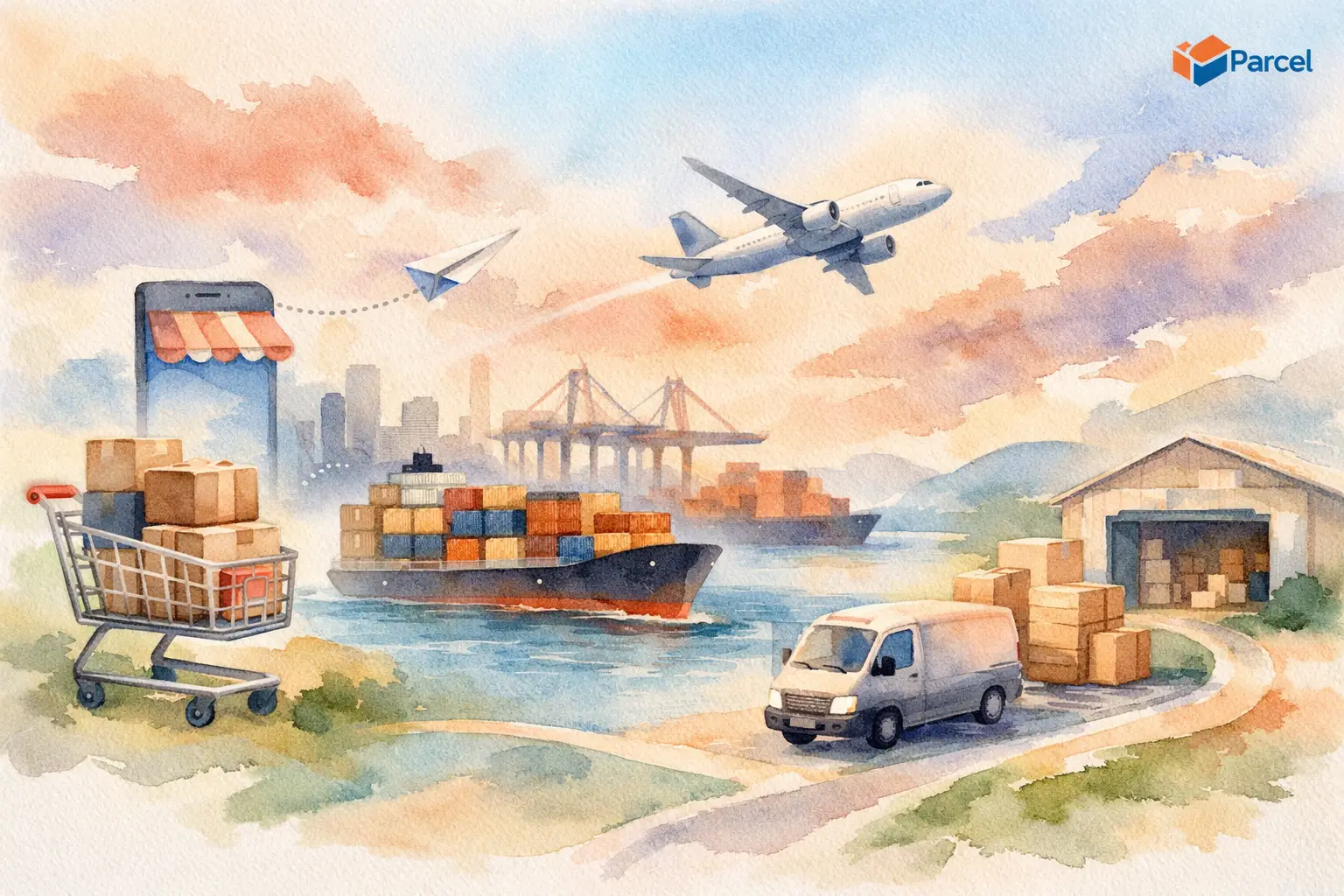
A late delivery used to be a customer-service issue. For an ecommerce brand, it can now affect marketplace ratings, repeat purchase rates, advertising efficiency, and the cost of managing returns. That is why ecommerce logistics trends are moving beyond faster shipping alone. The real priority is building an operating model that keeps orders, inventory, fulfillment, and delivery decisions connected as volume grows.
For operations leaders, the question is not which trend is most popular. It is which capabilities reduce manual work, protect the customer promise, and create room to scale without adding unnecessary fixed costs.
Ecommerce logistics trends are becoming operational standards
The most meaningful changes in logistics are not isolated tools. They are connected systems that turn fulfillment from a back-office function into a commercial advantage. A brand may acquire an order through TikTok Shop, sell the same SKU on Shopify and a marketplace, and deliver it to a customer who expects real-time updates. If each handoff requires a spreadsheet, a separate login, or a manual message, growth quickly creates friction.
The businesses that perform well treat logistics data as a shared operational layer. Inventory availability should inform what customers can buy. Order cutoffs should reflect actual warehouse capacity. Delivery exceptions should reach customer-service teams before customers need to ask. This level of coordination is becoming the baseline for brands that want to compete on both speed and reliability.
1. Multi-channel order management is replacing channel-by-channel operations
Customers do not see separate inventory pools for a brand’s website, marketplaces, social commerce pages, and retail partners. They see one brand and expect stock information to be accurate everywhere.
This is driving demand for centralized order management and inventory synchronization. When sales channels draw from the same inventory view, teams can reduce overselling, avoid duplicate order processing, and make smarter replenishment decisions. It also makes it easier to prioritize inventory for high-margin channels or key campaigns when supply is constrained.
The trade-off is that integration needs discipline. Connecting every possible sales channel without clear SKU standards, inventory rules, and exception workflows can create more confusion, not less. Start with the channels that produce meaningful order volume, then build reliable processes before expanding further.
2. Delivery speed is being matched with delivery precision
Same-day and next-day delivery remain important, particularly for urgent purchases, gifting, healthcare products, and urban shoppers. But speed by itself is not always the strongest customer promise. A customer who receives a clear delivery window, active notifications, and accurate tracking may be more satisfied than one given a vague promise of fast delivery.
This is why last-mile visibility is a major ecommerce logistics trend. Active recipient notifications through channels such as WhatsApp can reduce missed deliveries and inbound support questions. Live tracking gives customers a sense of control, while delivery proof and status updates give operations teams a factual record when issues arise.
Brands should be selective about where they offer premium delivery. Same-day delivery can improve conversion for certain products and locations, but it also requires tighter cutoff times, fulfillment readiness, and courier capacity. It works best when the commercial value of the order supports the added operational cost.
3. Fulfillment networks are becoming more flexible
Holding all inventory in one location may keep storage costs simple, but it can increase delivery time and shipping expense as demand expands. At the other extreme, distributing inventory across too many sites creates replenishment complexity and raises the risk of fragmented stock.
The practical answer depends on order density, product characteristics, and service-level requirements. Brands with concentrated demand may benefit most from one well-run fulfillment hub with dependable last-mile coverage. Brands serving multiple regions or carrying high-velocity items may need inventory positioned closer to demand.
Flexible outsourced fulfillment is gaining ground because it lets businesses adjust capacity without committing immediately to warehouse leases, equipment, labor, and fleet management. This is particularly useful during campaign peaks, product launches, and regional expansion. The partner still needs clear service levels, inventory controls, and reporting. Outsourcing responsibility should not mean outsourcing visibility.
4. Warehouse automation is becoming more practical
Automation is no longer limited to large distribution centers with major capital budgets. Warehouse teams increasingly use barcode workflows, mobile scanning, automated order routing, digital picking instructions, and packing validation to reduce errors and improve throughput.
For most growing brands, the first automation opportunity is not a robot. It is removing repetitive manual decisions. A picker should not need to guess which order is urgent. A packer should not have to search for a customer’s delivery preference. An operations manager should not need to reconcile stock movement across several files at the end of the day.
Technology should be introduced where it removes a measurable bottleneck. If order accuracy is the issue, focus on scan-based verification. If late dispatch is the problem, improve cutoff rules and pick-pack prioritization. If labor planning is difficult, use historical order patterns to forecast workloads. The best investment is the one that resolves the constraint limiting growth now.
5. Specialized logistics is moving closer to mainstream ecommerce
Not every ecommerce order is a standard parcel. Cold-chain goods, medical devices, sensitive electronics, regulated products, and corporate deliveries require different handling, documentation, and delivery controls.
As more specialized products move through online channels, brands need fulfillment partners that can maintain the required conditions from storage through final delivery. In healthcare and medical device distribution, compliance and traceability are operational requirements, not optional add-ons. A low delivery rate means little if the chain of custody cannot be verified.
This is also where a single logistics partner can reduce complexity. Rather than coordinating separate providers for warehousing, fulfillment, cold-chain handling, and last-mile delivery, businesses can benefit from one operating backbone with defined accountability. The right model depends on the product risk, delivery volume, and required service levels.
6. Returns are being designed as part of the customer experience
Returns have traditionally been treated as an unavoidable cost. That view misses an opportunity. A confusing return process can discourage a future purchase, while a clear and timely process can preserve trust even when the product was not right.
The logistics challenge is that every return needs a decision: restock, refurbish, quarantine, dispose, or send back to a supplier. Without defined rules, returned inventory can sit idle and distort available stock figures. Brands should connect return reasons to warehouse actions so teams can identify quality issues, sizing problems, inaccurate product descriptions, or recurring carrier damage.
A generous returns policy is not always the right answer. High-return categories need controls that protect margins. The goal is a process that is easy for legitimate customers, visible to the business, and disciplined enough to prevent avoidable losses.
7. Predictable cost is becoming a strategic advantage
Logistics costs are often difficult to forecast because they combine storage, handling, packaging, delivery zones, surcharges, failed deliveries, and peak-season fees. When costs are unclear, it becomes harder to set shipping thresholds, protect margins, or evaluate campaign performance.
Brands are placing greater value on transparent rate structures and performance reporting. Flat-rate delivery options can simplify planning for eligible service areas, while detailed fulfillment reporting helps operators understand the true cost per order. Neither model is automatically better. Variable pricing may fit a complex delivery footprint, while a flat rate can provide confidence for businesses with consistent order profiles.
The critical requirement is visibility. Finance, operations, and commercial teams should be working from the same view of fulfillment costs and service performance.
What to prioritize before adding more logistics providers
Many brands respond to growth by adding another courier, another warehouse, or another marketplace tool. Sometimes that is necessary. Often, it multiplies the number of handoffs without solving the underlying problem.
Before expanding the provider stack, review four operating questions: Is inventory accurate across every sales channel? Can orders flow automatically from checkout to fulfillment? Do customers receive clear delivery updates? Can the team identify exceptions before they become complaints?
If the answer to any of these is no, integration and process design should come before further expansion. uParcel’s model of selling, storing, picking, packing, and delivering through an integrated operation reflects where the market is heading: fewer disconnected workflows, more accountable execution.
The strongest logistics strategy is rarely the one with the most technology or the fastest advertised delivery time. It is the one that gives your team reliable control over the promises your brand makes, one order at a time.
Leave a Reply